It is a question that seems to pop up every time someone looks at their credit card statement and sees a dozen different subscriptions swirling around. With the way tech giants are gobbling up smaller companies lately, you would be forgiven for thinking that Jeff Bezos or the current Amazon leadership had simply written a massive check and tucked the Swedish streaming giant into their back pocket. But, to put it bluntly… no. Amazon does not own Spotify. As we navigate through the early stages of 2026, Spotify remains a fiercely independent, publicly traded company, though the lines of competition have become incredibly blurred. It is a bit of a wild goose chase trying to find a single owner for Spotify because the company is owned by a mix of its founders, Daniel Ek and Martin Lorentzon, along with a massive array of institutional shareholders like Tencent and Baillie Gifford.
The confusion usually stems from how deeply integrated these services have become in our daily lives. You ask your Alexa to play a song, and half the time, it pulls from Spotify instead of Amazon Music. This creates a weirdly cozy atmosphere between two companies that are actually trying to tear each other’s market share apart. Amazon Music has grown significantly, leaning hard into high-definition audio and its Prime ecosystem, while Spotify has doubled down on being the “everything app” for audio, including audiobooks and high-end video podcasts. Honestly, it is a classic case of being frenemies. They need each other to keep the hardware – the Echo speakers – and the software – the playlists – relevant, but they are definitely not under the same corporate roof.
If you really dig into the financial filings from last year, you can see that Spotify has fought tooth and nail to keep its independence. There were rumors, of course… there are always rumors. Some analysts suggested that Google or even Microsoft might make a play for them to counter Amazon’s growing influence in the home audio space. But Daniel Ek has always been pretty vocal about wanting to build something that lasts centuries, not just something to flip for a quick profit. It’s refreshing, in a way? In a world where every cool startup eventually gets swallowed by a conglomerate, Spotify is still doing its own thing, for better or worse. They’ve had their fair share of struggles with royalty payments and artist disputes, which is a bitter pill to swallow for many creators, but they remain the top dog in terms of pure user numbers.
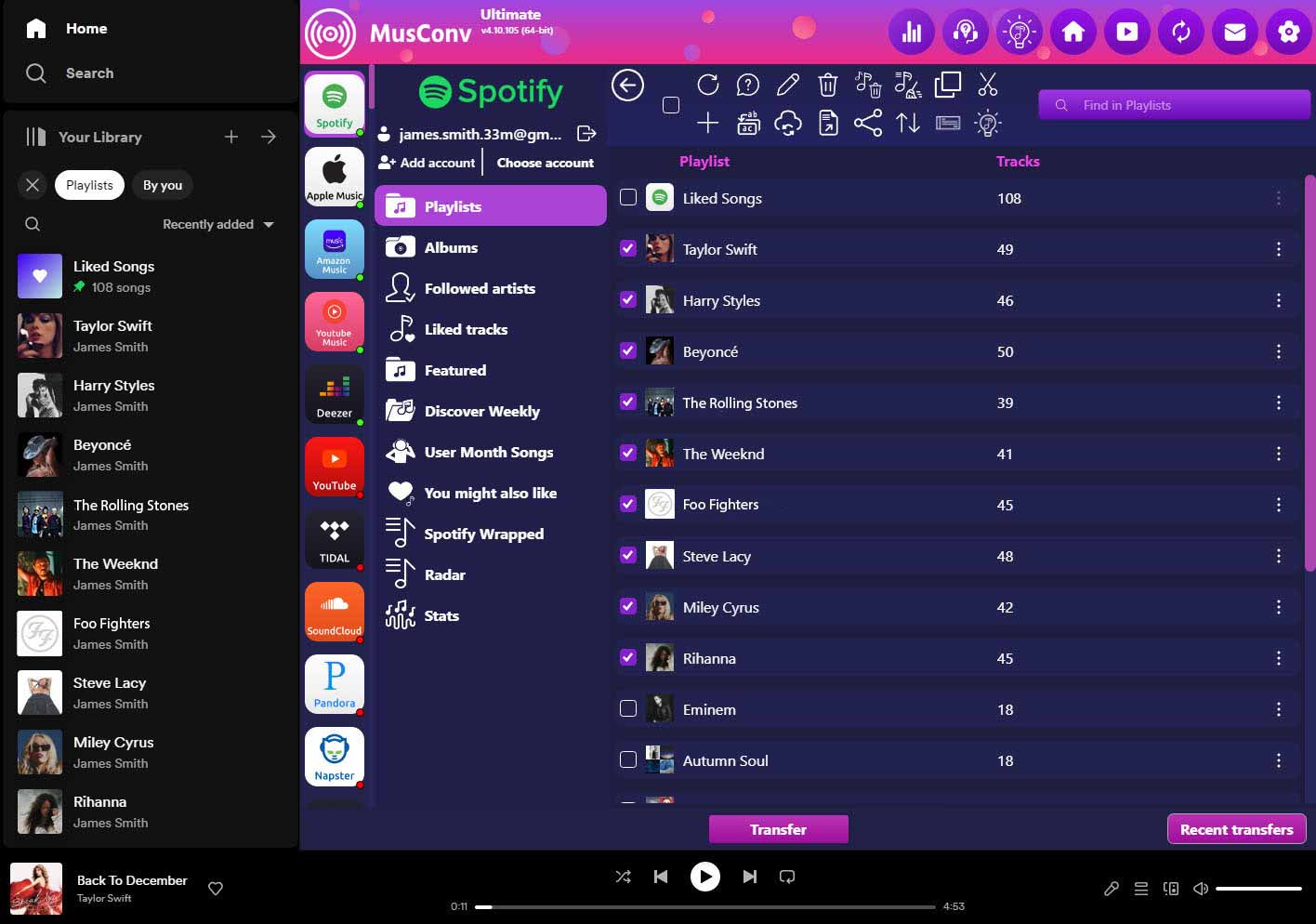
Because these companies are constantly competing for your attention, users often find themselves jumping from one to the other to catch a better deal or a specific exclusive podcast. This constant platform-hopping is where things usually get messy for the average listener. Instead of spending an entire weekend manually rebuilding your libraries and trying to remember which tracks you saved three years ago, you can use a clever tool called MusConv to shift your entire musical identity. It acts as a bridge between over 125 different platforms, effectively migrating your playlists and favorite albums between services like Amazon Music, Spotify, and YouTube Music with just a few clicks. It takes the stress out of switching providers because it handles the heavy lifting… which is exactly what we need when big tech companies refuse to play nice with each other.
The Tech Landscape Of 2026: What Lies Ahead?
Amazon, on the other hand, operates with a completely different philosophy. For them, music is just another “hook” to keep you inside the Prime ecosystem. They don’t need Amazon Music to be profitable on its own as long as it keeps you buying groceries and electronics from their store. Spotify doesn’t have that luxury. If people stop paying for Spotify Premium, the company is in hot water. This fundamental difference in their business models is why a merger or acquisition doesn’t really make much sense right now. Why would Amazon buy a company with such high overhead when they can just keep building their own competing service using their nearly bottomless pit of cash?
Looking at the trends for the rest of 2026, the rivalry is only going to get more intense. We are seeing a massive shift toward AI-generated playlists that are tailored to your actual heart rate or the time of day. Amazon has the advantage here because they own the hardware – the rings, the watches, and the speakers. Spotify has to rely on partnerships. But don’t count the Swedes out just yet. Their data on how people actually listen to music is still the gold standard in the industry.
There is also the question of “exclusive” content. We saw a brief period where artists were picking sides, but that has mostly faded because, let’s be honest, musicians want to be everywhere. They want the reach of Spotify and the raw purchasing power of the Amazon audience. It’s a delicate balance. Will Amazon eventually try to buy Spotify if the stock price ever takes a massive dip? Maybe. But for now, they are two separate ships sailing in the same direction, occasionally bumping into each other but never quite merging. It is a fascinating drama to watch from the sidelines, provided you don’t get too caught up in the corporate jargon.
In the end, it doesn’t really matter who owns what as long as the music keeps playing, right? Well, until the next price hike, at least. Just keep your eyes on the news and your playlists backed up. You never know when the next big shift is coming in this fast-moving industry… and it usually happens when we least expect it.
MusConv is a cross-platform migration tool that simplifies switching between music ecosystems. It serves as an automated assistant that gathers your curated content and replicates your entire musical footprint on a different streaming service.
Does the tool support niche or high-fidelity streaming services?
Absolutely. Beyond popular mainstream apps, the software covers a vast array of platforms, including Hi-Fi services, ensuring that audiophiles can move their lossless collections without losing their meticulously organized playlists.
What happens to my play counts and listening history?
While the tool excels at moving playlists, albums, and tracks, some platform-specific data like "play counts" may stay behind due to service limitations. However, it successfully recreates your library's structure so your musical identity remains intact.
Can I export my playlists to a file format like CSV or Excel?
Yes, the program allows you to back up your music data into various file formats. This is perfect for users who want a physical record of their library or wish to manage their music database using spreadsheet software.